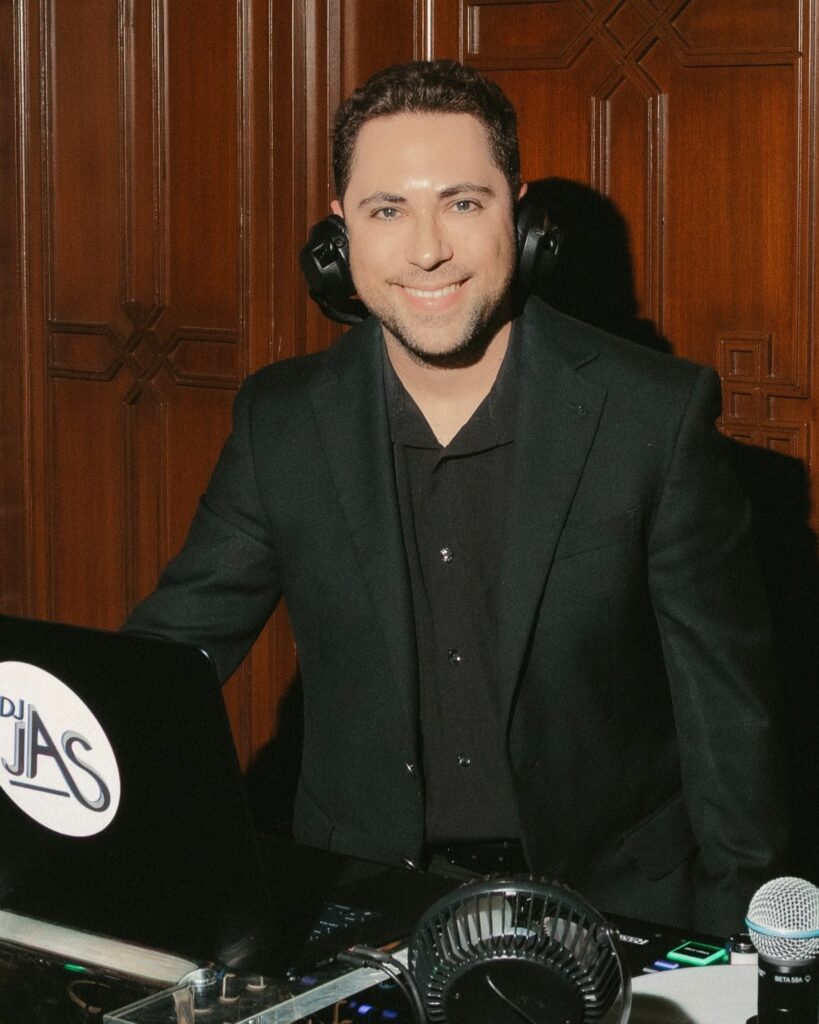
If you’re planning a wedding in Santa Barbara, Montecito or the Santa Ynez Valley, the DJ is one of the line items that varies the most from quote to quote. I’ve DJed more than 500 weddings over 20+ years, so here’s an honest look at what wedding DJs cost, what changes the price, and what to ask before you sign anything.
The short answer
According to The Knot’s 2026 Real Weddings Study, which surveyed more than 10,000 couples married in 2025, the average wedding DJ in the U.S. costs about $1,800.
That average blends very different packages. Many lower quotes cover four or five hours at the reception only, with ceremony sound, cocktail-hour music, lighting and overtime added on later. Higher-end packages usually include all of that from the start, along with more planning and a more experienced DJ, so you and your guests get a much better experience overall. For a full Santa Barbara wedding day, start with the all-in price for everything you actually need, but don’t stop there. Even with identical packages, two DJs can deliver completely different nights, because style and skill are what fill the dance floor.
What changes the price
- Hours of coverage. Is it reception only, or ceremony, cocktail hour, dinner and dancing?
- Separate sound setups. Ceremonies and cocktail hours often happen in different spaces from the reception, and each needs its own speakers and microphones.
- Sound coverage. Big rooms, tents and unusual layouts need more than two speakers by the DJ booth. Ask how the DJ reaches the back of the room without blasting the front.
- Lighting. Dance floor lighting and up-lighting are often extra.
- MC work. Announcements, timeline management and coordinating with your planner and other vendors.
- Skill. A performance DJ who mixes live (mashups, tempo swings, creative transitions) and reads the room is a different service from someone pressing play on a playlist.
- Proof of live mixing. A DJ who can show you multiple videos of themselves mixing live at real events has proven skill, not just a promise of it.
- Customer service and the overall experience. A DJ who walks you through every detail, from your timeline and song choices to coordinating with your vendors, takes the stress off your plate so you can actually enjoy your wedding.
- Backup and insurance. Backup speakers and cables only go so far. The laptop runs the whole night because it’s where all the music is stored. That means the only real backup is a second laptop that’s fully cloned and synced to the main one, ready to take over instantly if anything fails. Few DJs bring one. Ask for a certificate of insurance for your venue, too.
- Travel and overtime. Ask what’s included and what the hourly rate is if you want to keep dancing.
Questions to ask every DJ
- How many hours are included, and what does overtime cost?
- Is ceremony sound included, with microphones for your officiant and vows?
- How will you cover the back of the room and any far areas? Do you add speakers there, or just turn the main ones up?
- Is lighting included, or is it an add-on?
- Will you be my DJ, or will a company assign someone from a roster?
- Can I watch videos of you mixing live at real weddings?
- Do you bring a fully cloned backup laptop, and can you send my venue a certificate of insurance?
- Are there any setup, breakdown or travel fees?
What I charge, and what’s included
My all-inclusive wedding package is $5,000 for weddings in Santa Barbara, Ventura and Los Angeles counties. It includes:
- Eight hours of DJ and MC time
- Separate sound for your ceremony, cocktail hour, dinner and dance floor
- Wireless speakers placed in the back and far areas of your reception, so every guest hears clear, even sound
- Battery-powered wireless speakers and invisible lapel microphones for the ceremony
- Full-room up-lighting and dance floor lighting
- A modern DJ booth, online planning tools and one-on-one planning with me
- A fully cloned and synced backup laptop at every wedding, plus backup equipment, backup music and full insurance
There are no setup, breakdown or travel fees within those three counties. The only extras are overtime ($800 per hour) and travel outside Santa Barbara, Ventura and Los Angeles counties. Half down reserves your date, and payment plans are available.
What your guests will notice
Clear, even sound in every corner
Most DJs run the whole room off two speakers beside the DJ booth. In a big ballroom, a long tent or a venue with an unusual layout, the only way to reach the back is to turn those speakers way up. Guests near the front get blasted, guests at the far tables still strain to hear the toasts, and dinner conversation turns into shouting.
I place extra wireless speakers in the back and far areas of your space, wherever the room needs them. Because the sound comes from several spots instead of one, I never have to crank the main system to fill the room. Your grandparents at the back table hear every word of the toasts, the dance floor gets all the energy it needs, and everyone in between can still talk. It’s included in my all-inclusive package.
Mixing that builds the whole night
Basic mixing is one song fading out and the next one fading in. It gets the music played, but the energy dips between songs, and over a night those dips add up to a dance floor that comes and goes.
I’m a performance DJ, and my mixing is built around momentum. It features creative, stylized transitions across every genre and decade, plus live mashups that layer two songs into something new, tempo swings that lift the floor from a groove into a peak, acapella blends, quick cuts, specialty edits, and the unexpected track at the perfect time. I go for that gut reaction on every transition, so each song hits harder than the last instead of resetting the energy. Every mix happens live, in the moment, built around your musical taste and style, and what the crowd is feeling right then. I get to know you and the music you love before the wedding, so the whole night feels like yours. Your guests don’t just hear their favorite songs. They hear them in ways that make them cheer and run back to the dance floor.
Two DJs can play a lot of the same songs, and one party feels unforgettable while the other dies early. The mixing is the difference, and it’s easier to show than describe: see it for yourself on Instagram.
What couples say
“Our guests are still talking about how they’ve never seen a dance floor go non-stop for 3 hours.”
Chris Vogl
“Justin rose to the occasion and mixed a blowout set that got everyone moving!”
Elijah Cooksey
“Not a single mic issue, sounds were never too low.”
Stuart Campbell
Why I charge what I do
Those averages describe a different kind of DJ. If you only need background music and a few announcements, a basic package may be all you need. The couples who book me want something more: DJing as a creative, artistic craft, for people who care about the details and notice the difference.
That craft lives in decisions most guests never see but everyone feels:
- Song choice. The right songs for your crowd and your story, not the same list every wedding DJ plays.
- Timing. Knowing exactly when to play each song, and when to hold one back for a bigger moment.
- How each song is played. Which part of a song to bring in and which to skip, so every song lands at its best.
- Reading the room. Adjusting in real time so the dance floor stays full from the first dance to the last song.
Then there’s the service. You get one-on-one planning with me, quick answers to every call and text, and a complete DJ service with everything taken care of: ceremony, cocktail hour, dinner and dancing, sound, lighting and MC, all for one price. Couples mention that responsiveness in their reviews again and again.
I personally DJ every wedding I book, so the person you meet on Zoom is the person behind the booth on your wedding day. That’s why I charge what I do. Here’s more on why a wedding DJ isn’t an hourly service.
Next steps
See everything that’s included on my Pricing page, read the FAQ, or check your date. Most couples book about a year out, and popular Saturdays go first.